Is Roof Rejuvenation Like Sealcoating a Driveway?
How Asphalt Shingle Rejuvenation Works — and When It Makes Sense
If you have ever sealcoated an asphalt driveway, you already understand the basic idea behind roof rejuvenation.
You do not sealcoat a driveway after it has completely failed. You do it while the asphalt is still in good enough condition to protect, maintain, and extend its useful life.
Roof rejuvenation works from a similar maintenance mindset.
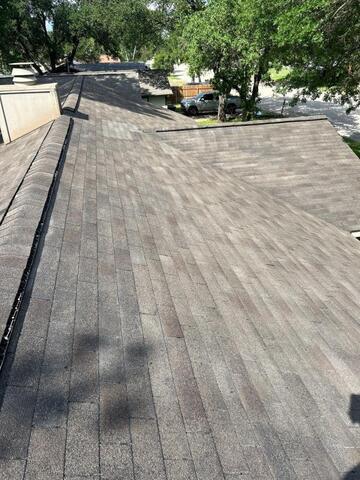
Here in New Braunfels and the Texas Hill Country, asphalt shingle roofs take a beating from heat, sun, wind, hail, and fast temperature swings. Over time, the asphalt inside the shingle can dry out, stiffen, and lose flexibility. Once shingles become too brittle, they are more likely to crack, lift, shed granules, or fail during severe weather.
That is where roof rejuvenation may help — but only on the right roof.
What Is Driveway Sealcoating?
Driveway sealcoat is a black liquid applied to asphalt pavement to help protect and improve the appearance of the surface. The U.S. Geological Survey describes pavement sealcoat as a product commonly applied to asphalt driveways, parking lots, and playgrounds to protect and enhance the underlying asphalt.
In plain English, sealcoating is maintenance.
It does not rebuild a failed driveway. It does not fix major base problems. It does not make potholes disappear. But when applied at the right time, it can help protect asphalt before deterioration gets worse.
That is the comparison homeowners usually understand.
How Is Roof Rejuvenation Similar?
Asphalt shingles are not the same as asphalt pavement, but they do share one important thing: asphalt is part of the system.
An asphalt shingle is made to be flexible enough to expand, contract, and perform through years of heat, sun, wind, and rain. But as shingles age, the asphalt components can lose flexibility. InterNACHI notes that shingles become more brittle as the materials that keep them flexible dissipate, and granule loss can increase UV exposure to the asphalt.
Roof rejuvenation is designed to treat aging asphalt shingles before they are too far gone.
Think of it this way:
You sealcoat a driveway before it crumbles.
You rejuvenate a roof before the shingles become too brittle to maintain.
It is not roof replacement. It is roof maintenance.
How Fresh Roof Is Different From Driveway Sealcoat
This is where the analogy has limits.
Driveway sealcoat is mostly a surface treatment. It sits on top of the pavement to protect and improve appearance.
Fresh Roof is marketed differently. Fresh Roof says its GreenSoy™ Technology is designed for asphalt shingle restoration and is intended to penetrate the shingle, restore flexibility, and improve performance rather than simply coating the surface. Fresh Roof also states that its treatment comes with a 6-year warranty and is designed as an alternative maintenance option for qualified asphalt shingle roofs.
So the simple comparison is this:
Driveway sealcoat protects aging asphalt pavement. Roof rejuvenation helps maintain aging asphalt shingles.
But they are not the exact same product, and they do not work the exact same way.
What Roof Rejuvenation Can Help With
For the right roof, rejuvenation may help with:
- Dry, aging asphalt shingles
- Loss of shingle flexibility
- Faded or weathered appearance
- Early brittleness
- Minor age-related wear
- Extending the useful life of a roof that is still structurally sound
Fresh Roof states that its formula is designed to restore nearly 50% of overall structural flexibility in shingles and improve resistance to wind lift and hail-related damage. Those are manufacturer claims, so homeowners should still have the roof inspected before assuming the product is a fit.
What Roof Rejuvenation Will Not Fix
This is the part homeowners need to hear clearly.
Roof rejuvenation is not a magic fix for a failed roof.
It will not fix:
- Active roof leaks
- Rotten decking
- Bad flashing
- Missing shingles
- Severe granule loss
- Poor ventilation
- Storm damage that requires replacement
- Shingles that are already too brittle or breaking apart
- Installation mistakes from the original roof system
If your roof has major system problems, rejuvenation is probably not the right answer by itself.
That is why we inspect the roof first.
The Best Way to Think About It
The best way to explain roof rejuvenation is:
Maintenance, not magic.
Just like sealcoating a driveway does not replace a failed driveway, roof rejuvenation does not replace a failed roof.
But if your roof is still in decent condition, and the shingles are beginning to show age, rejuvenation may be a smart way to buy more time before a full replacement.
For many homeowners in New Braunfels, Canyon Lake, Seguin, San Marcos, and the surrounding Hill Country, that can be an important option — especially when a full roof replacement can be a major investment.
When Does Roof Rejuvenation Make Sense?
Roof rejuvenation may make sense if:
- Your roof is aging but not failing
- The shingles still have reasonable granule coverage
- There are no major active leaks
- The roof deck is solid
- Flashings and penetrations can be repaired or tuned up
- You want to extend the life of the current roof before replacement
- You are preparing to sell and want a cleaner roof story for buyers, inspectors, and Realtors
This is especially helpful for homeowners who are not ready to replace the roof but do not want to ignore it either.
When Is Replacement the Better Option?
Replacement may be the better option if:
- Shingles are cracking, splitting, or breaking apart
- Large areas have missing granules
- There are repeated leaks
- The roof has widespread storm damage
- The decking is soft or damaged
- The roof is near the end of its service life
- Repairs would only delay the inevitable for a short time
A good roofing company should be willing to tell you both answers.
Sometimes rejuvenation makes sense.
Sometimes repair makes sense.
Sometimes replacement is the honest answer.
Our Approach: Inspect First, Recommend Second
At Klaus Roofing Systems of Texas Hill Country, we do not believe every roof should be rejuvenated.
We inspect the roof first and look at the full system: shingles, flashings, pipe penetrations, valleys, ventilation, decking concerns, and signs of leaks or storm damage.
If the roof qualifies, we can explain whether rejuvenation is a smart maintenance option.
If it does not qualify, we will tell you that too.
The goal is not to sell a treatment. The goal is to give you the right recommendation for your roof, your home, and your timeline.
Final Answer
Yes, roof rejuvenation is similar to sealcoating a driveway in one important way:
Both are maintenance treatments designed to help extend the life of asphalt-based materials before they fail.
But roof rejuvenation is not simply “paint for your roof,” and it is not a replacement for proper roofing repairs or a full roof replacement when the roof is already too far gone.
For the right asphalt shingle roof, Fresh Roof rejuvenation may be a smart way to preserve flexibility, improve appearance, and delay replacement.
For the wrong roof, it is not the answer.
That is why the inspection matters.
Not every roof needs to be replaced.
Not every roof qualifies for rejuvenation.
The right answer starts with an honest inspection.
Put a Klaus on your house.